THIS WEBSITE INCLUDES GENERAL INFORMATION & THE OPINIONS OF CHRISTOPHER S. MULVANEY. IT IS INTENDED TO STIMULATE A BASIS FOR QUESTIONS RELATED TO YOUR PARTICULAR FACTUAL CIRCUMSTANCES — BEFORE YOU ACT. THIS WEBSITE DOES NOT CONSTITUTE LEGAL ADVICE. IF YOU WANT LEGAL ADVICE, PLEASE MAKE A ZOOM APPOINTMENT TO SPEAK WITH ME.
CONTACT CHRISTOPHER S. MULVANEY FORM
DISCLAIMER:
The use of email or this form for communication with MULVANEY LAW OFFICE, PLLC does not establish an Attorney-Client Relationship. If you don’t think I have responded, please check your spam folder. Time-sensitive information should not be sent through this Form or through email. Sensitive information can be uploaded to an encrypted Dropbox folder in your client file. Google Review LinkYelp Review Link
Gonzaga University School of Law – Spokane, Washington – Class of 2002 – Cum Laude The Latin phrase “Deo patriae, scientiis, artibus” translates to “For God and country through sciences and arts”. The initials A.M.D.G. on the seal of Gonzaga Law School stand for Ad Majorem Dei Gloriam, which is Latin for “For the Greater Glory of God” the Motto of the Society of Jesus (Jesuits): a Catholic religious order founded by St. Ignatius of Loyola.
_________________________
ESTATE PLANNING & PROBATE
ATTORNEY IN BELLEVUE
A revocable living trust creates distinct rights and responsibilities for three primary parties: the grantor, the trustee, and the beneficiaries. During the grantor’s lifetime, they typically hold all three roles simultaneously, retaining full control over the trust’s assets.
When the grantor dies or becomes incapacitated, the roles are assumed by others, and the rights and responsibilities change.
Rights and responsibilities created by a trust document
The rights and duties of all parties are defined by the legally binding trust document, according to the grantor’s instructions. These obligations are further governed by state laws.
For the grantor (or settlor)
Rights:
To create, amend, or revoke the trust at any time while they are mentally competent.
To add or remove assets and change beneficiaries or the terms of the trust.
To be the primary beneficiary of the trust assets and income during their lifetime.
Responsibilities:
To properly fund the trust by re-titling assets in the name of the trust. If assets are not retitled, they will not be governed by the trust and may have to go through the probate process.
To appoint a successor trustee who will manage the trust if the grantor becomes incapacitated or dies.
For the trustee
During the grantor’s lifetime, the grantor serves as the initial trustee. The successor trustee’s active duties begin upon the grantor’s death or incapacity.
Rights:
To manage and control the assets held in the trust.
To receive reasonable compensation for their services, as outlined in the trust document
Responsibilities:
To fulfill a fiduciary duty, which requires acting in the beneficiaries’ best interests.
To follow all trust instructions regarding asset management and distribution.
To manage the trust’s investments prudently.
To keep detailed records and provide accountings of the trust’s financial activities to the beneficiaries.
To pay taxes and other expenses owed by the trust.
To avoid conflicts of interest or commingling personal assets with trust assets.
To distribute assets to beneficiaries after the grantor’s death or as otherwise instructed by the trust.
For the beneficiaries
During the grantor’s lifetime, other beneficiaries have very limited rights because the grantor can change or revoke the trust at any time. The beneficiaries’ rights become more concrete after the grantor’s death, when the trust becomes irrevocable.
To cooperate with the trustee during the administration of the trust.
The law of Trusts and Probate is contained in Title 11 of the Revised Code of Washington.
Rights:
To receive timely distributions from the trust as directed by the trust document.
To receive information and accountings about the trust and its administration.
To hold the trustee accountable for their fiduciary duties.
To petition a court for the removal of the trustee if they act improperly.
Responsibilities:
To pay taxes at the beneficiary’s tax rate on any income distributions they receive from the trust as reported to the beneficiary on IRS Form K-1. Principal distributions are not taxed to the beneficiary regardless of whether the principal was above $3 million and taxed pursuant to the Washington Estate Tax.
Retained earnings are taxed at a higher rate because the maximum tax rate is reached at a lower level of earnings. Income tax bracket (2025) Trust or estate (income over) Single individual (income over) 10% $0 $0 12% N/A $11,925 24% $3,150 $103,350 32% N/A $197,300 35% $11,450 $250,525 37% $15,650 $626,350
What is estate planning? It is the general term that applies to a range of documents designed to allow your loved ones to handle financial and health decisions if you are unable to do so, and to allow your loved ones to administer your estate (take inventory of everything owned and owed on the date of death, pay taxes, pay creditors, and distribute the remainder to beneficiaries) after you die.
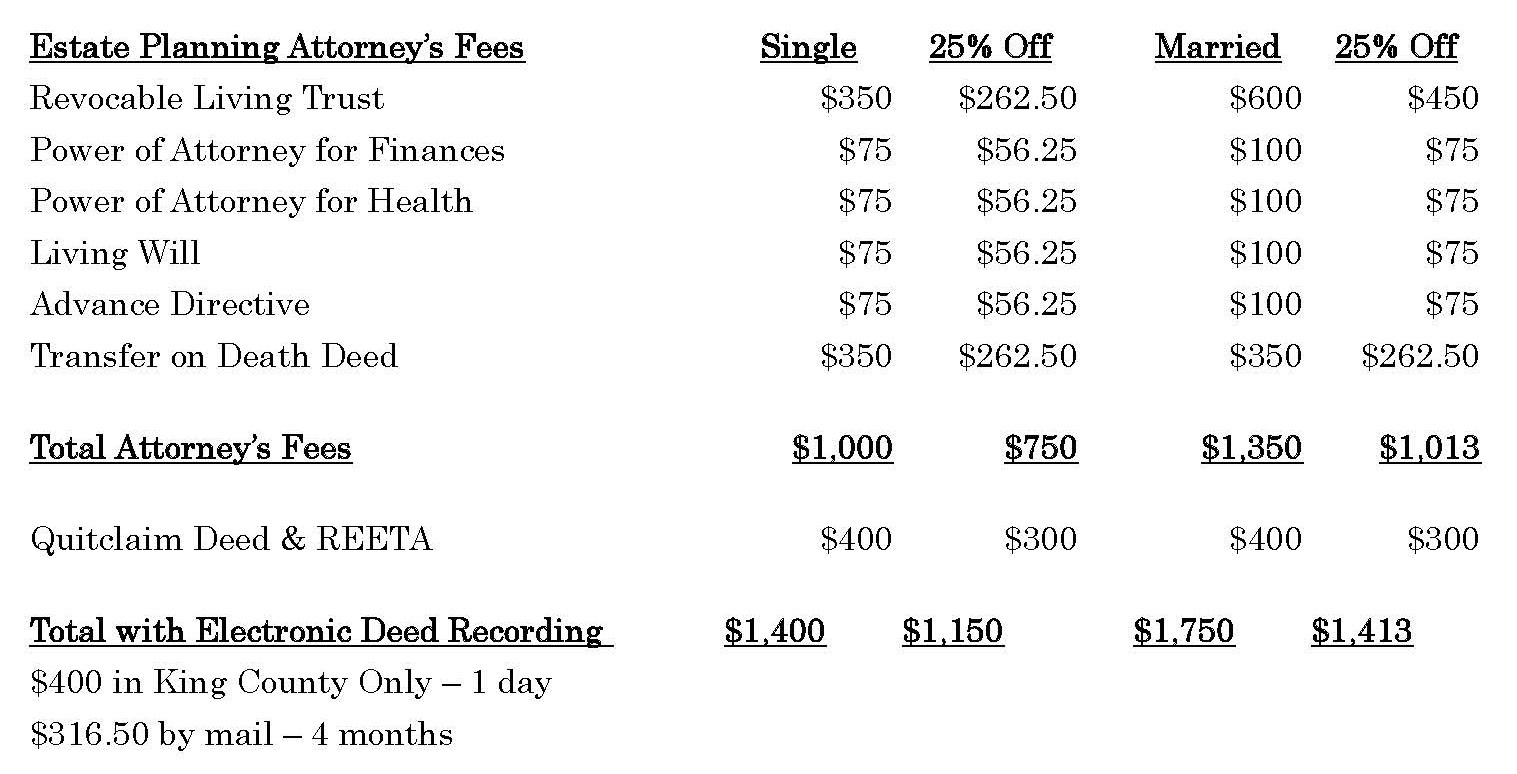
These documents include: powers of attorney for finances and health, living wills, advance directives, revocable living trusts, transfer on death deeds, quitclaim deeds, beneficiary designations and Wills.
Before discussing practical aspects of Estate Planning I would like to give an overview of what I see as the purposes and benefits of planning which I hope will guide you through the process more effectively.
Something like two-thirds of people do no planning for when they pass away. The majority of people put their head in the sand and pretend they are never going to die. That is why, I believe, there are so many disputes and horror stories including litigation and estrangement involving Estates. If you do no planning, it is not surprising that more things are likely to go wrong. So, the primary purposes of Estate Planning as I see them are:
(1) Promoting family harmony and reducing the likelihood of disputes by getting your family on the same page as to your wishes, so that your are more likely to be carried out peacefully preserving the cohesiveness of your surviving loved ones.
(2) Reducing anxiety and increasing your sense of being organized and in control of your life by taking an inventory of the people, property, and debt you have, and your wishes and goals.
(3) Increasing gratitude and kindness through mortality awareness. If you keep in mind who and what is important to you in your life, it can aid in making decisions consistent with your values, and can increase your sense of well being. Mortality awareness can bring perspective and peace.
(4) Projecting the love you have for your family and friends beyond your lifetime, so that your surviving loved ones feel loved long after you are gone. For example, my grandfather died in 1978 and my grandmother died in 1991. I carry their love for me today. I feel a comforting connection to my past along with the loss.
(5) Thinking about how you would like to be remembered, your legacy, can decrease the likelihood of bad decisions and increase the chances of making choices for which you and your loved ones can be proud. If you don’t want to be remembered as an angry or abusive person, for example, thinking about the positive effect you could have on your loved ones by changing your behavior can be motivation to change.
Notice that none of these purposes involve passing on property. That is the least important of reasons for doing an Estate Plan. I believe Estate Planning is for everyone, no matter how little property you have or no matter how small your circle caring is. Estate Planning is life planning. It is communication with people you are there for and who are willing to be there for you. Letting people know how much you care about them, and that you count on them, and that they can count on you is empowering. If you put people above property at all times, and make your wishes about your property serve to communicate a token of your love then you will stay true to who and what you are and not get distracted by things that don’t matter. Treasure what matters to you. Celebrate and be grateful for it. Do Estate Planning to pass that Love that transcends Death on to your surviving loved ones.
THE PROCESS
All meetings are in ZOOM. All signing and notarization is via DocuSign in ZOOM.
The appointment to execute the documents takes 45 minutes to an hour depending upon questions. If you make a list of your questions to ask at the appointment rather than emailing them in advance, the process will be much smoother.
If you give me the names of your spouse and children, if applicable, and the names of two people you trust, then I can prepare a draft for review. Do not be concerned at all if you are not sure or you haven’t asked the person if they will do the job. Those things are completely irrelevant to preparation of the draft and will all be resolved later in the process.
The draft is important because it allows you to read your proposed instructions with then names of proposed administrators to distribute to beneficiaries. People find seeing their proposed wishes and administrators in writing clarifying of their wishes which is the purpose of estate planning.
Before I went to law school I was a reporter. I found that one of the best ways to get information was to say something that was close, but just a little bit wrong. My sources were more than happy to correct me. The same applies for estate planning. If you let me prepare a draft, then you will be happy to tell me what is wrong with it. Where as if I ask you the questions directly, you will be much more hesitant and likely have a lot of questions before answering that will be answered by reading the draft. I hope that helps.
(2) You can list all of your assets and debts on the attached spreadsheet to create the exhibits.
(3) Most people realize that once separate property is segregated and labeled and the supporting documents of deeds for real estate and/or consent forms for naming your Separate Property Trust as primary beneficiary are done, that a Postnuptial Agreement is not needed because they want to hold everything acquired after marriage except for gifts and inheritance as community property. Community Property is presumed. An agreement is not needed.
Separate property requires written records.
Postnuptial Agreement cost is $1,500.
Estate Planning is about people and relationships – not paper and property.
Something you need to understand is that the standard forms themselves are of very little value. You can get the forms for free. Not just from MetLife, but from other online providers (such as the website with the statutory language for the forms). The value is in the understanding of what everything in the process means, and how to use that understanding for the benefit of yourself and your family and the relationships amongst everyone you list in your estate plan. You can’t get that from a form.
My forms are vastly better than free forms, and contain many links to additional information. One reason they are better is that they are continuously modified based on the questions and reactions of several thousand previous clients. The mistakes of previous clients are listed as warnings to future clients. No free “boilerplate” form can do that.
I look forward to meeting you and explaining how to get the most out of your estate planning documents.
To Always Be a Human Being First, and My Role Second. To First, Do No Harm, then to provide the best legal outcome, smoothest process, best value, and to make a positive difference in the life of every client.
Christopher S. Mulvaney’s Mantra:
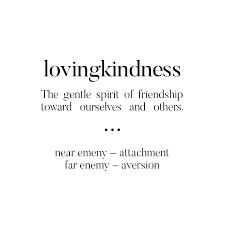
May I be filled with loving kindness for all life. May I be safe from dangers within and without. May I be healthy in body, mind, socially, and spiritually. May I be at ease and happy, doing good in the world.
May You be filled with loving kindness for all life. May You be safe from dangers within and without. May You be healthy in body, mind, socially, and spiritually. May You be at ease and happy, doing good in the world.
I am an experienced solo estate planning, debtor bankruptcy, and real estate attorney. At my law firm in Bellevue, Washington between Eastgate and Factoria, I do things a little differently. I am passionate about helping people take control of their lives.
One of my primary practice areas is urgent (bankruptcy), and the other is important, but not urgent (estate planning). Not letting the urgent crowd out the important is key. I have made a choice to include the positive difference I make in the life of each client in how I calculate profit. This means I have higher job satisfaction, and happy clients who confidently give referrals.
My goal is that my work is transformative for people during a challenging time in their lives. At Mulvaney Law Offices, PLLC (MLO), you will not find a gatekeeper. There are no forgotten cases hiding on an associate’s cluttered desk. It’s just me, working with each one of my clients one-on-one to resolve their legal concerns as favorably as possible.
As your lawyer, I will personally handle every aspect of your case. My office is not a factory churning out thousands of filings per year, where each case matters little. You, and your case, matter to me. You can see what clients have said about me, and leave your own reviews at these links.
Mulvaney Law Offices, PLLC is located in Bellevue, Washington, representing estate planning & chapter 7 and chapter 13 bankruptcy, clients in all 39 Washington Counties.
Washington State residents can meet with me in Zoom/DocuSign from anywhere in the world, and I can notarize their electronic signatures because I am a remote online notary. Just email me an image of your photo ID.