THIS WEBSITE INCLUDES GENERAL INFORMATION & THE OPINIONS OF CHRISTOPHER S. MULVANEY. IT IS INTENDED TO STIMULATE A BASIS FOR QUESTIONS RELATED TO YOUR PARTICULAR FACTUAL CIRCUMSTANCES — BEFORE YOU ACT. THIS WEBSITE DOES NOT CONSTITUTE LEGAL ADVICE. IF YOU WANT LEGAL ADVICE, PLEASE MAKE A ZOOM APPOINTMENT TO SPEAK WITH ME.
CONTACT CHRISTOPHER S. MULVANEY FORM
DISCLAIMER:
The use of email or this form for communication with MULVANEY LAW OFFICE, PLLC does not establish an Attorney-Client Relationship. If you don’t think I have responded, please check your spam folder. Time-sensitive information should not be sent through this Form or through email. Sensitive information can be uploaded to an encrypted Dropbox folder in your client file. Google Review LinkYelp Review Link
Gonzaga University School of Law – Spokane, Washington – Class of 2002 – Cum Laude The Latin phrase “Deo patriae, scientiis, artibus” translates to “For God and country through sciences and arts”. The initials A.M.D.G. on the seal of Gonzaga Law School stand for Ad Majorem Dei Gloriam, which is Latin for “For the Greater Glory of God” the Motto of the Society of Jesus (Jesuits): a Catholic religious order founded by St. Ignatius of Loyola.
_________________________
Imputed income means the IRS is collecting income tax on income you did or didn’t receive because of a choice you made.
For forgiven debts of solvent people, the amount forgiven is considered taxable income.
For people who give free or discounted rent to family members, the difference between the market rent and the rent received is considered taxable income.
If a loan is made to a family member for no interest or very low interest, then the difference between interest received and the Applicable Federal Rate (AFR), (which varies for short-term (3years or less), mid-term (4 to 9 years) & long-term (over 9 years)). is taxable to the recipient.
If a party in a divorce voluntarily refuses to work, income can be imputed by the Court to calculated child support and/or spousal support.
When a lawyer discusses imputed income with a client, the conversation should focus on two main contexts: family law and tax law. In family law, such as divorce, it is a court’s way of assigning a higher income to a party who is voluntarily earning less to reduce child or spousal support. In a tax context, imputed income is the monetary value of taxable, non-cash benefits an employer provides to an employee.
Imputed income in family law
A lawyer must explain that a family Court can assign a higher income to an individual for the purposes of calculating child support and alimony, even if they are not actually earning that amount. This is done to ensure fair support payments and discourage a party from intentionally lowering their income to minimize their financial obligations.
Key points for clients include:
What it is: The Court concludes that a party has an earning capacity greater than their current income, and uses that higher figure when calculating support payments.
Reasons for imputation: Imputation can occur when a party is voluntarily unemployed or underemployed. Examples include:
Quitting a high-paying job for a lower-paying one without a valid reason.
Intentionally reducing work hours or refusing a promotion.
Failing to make diligent efforts to find new employment after a job loss.
Hiding or failing to report income and assets.
Factors the Court considers: The lawyer should review how a court determines earning capacity, which involves looking at several factors:
The client’s skills, work history, and education.
The job market and availability of jobs in their area.
Their age and health.
Childcare responsibilities.
Potential for expert testimony: If the case is contested, the lawyer may need to explain how a vocational expert could be used to provide an opinion on the client’s earning capacity, adding to legal costs.
Tax consequences: If a court imputes income, the client could face significant financial hardship because they may have to pay a higher support amount based on income they don’t actually receive.
Imputed income for tax purposes
Lawyers should advise clients about the tax implications of non-cash benefits they receive from their employer. These benefits are added to an employee’s gross income and are subject to taxes, including FICA (Social Security and Medicare).
Essential details for clients include:
Payroll and W-2 implications: The lawyer should explain that an employer is responsible for calculating imputed income and adding it to the client’s gross wages. The total taxable amount is reported on the employee’s Form W-2. This can affect an employee’s take-home pay through tax withholding, even though they do not receive the cash.
What it is: The monetary value of a fringe benefit that is considered taxable compensation, even though no cash is exchanged. The fair market value is typically used for valuation.
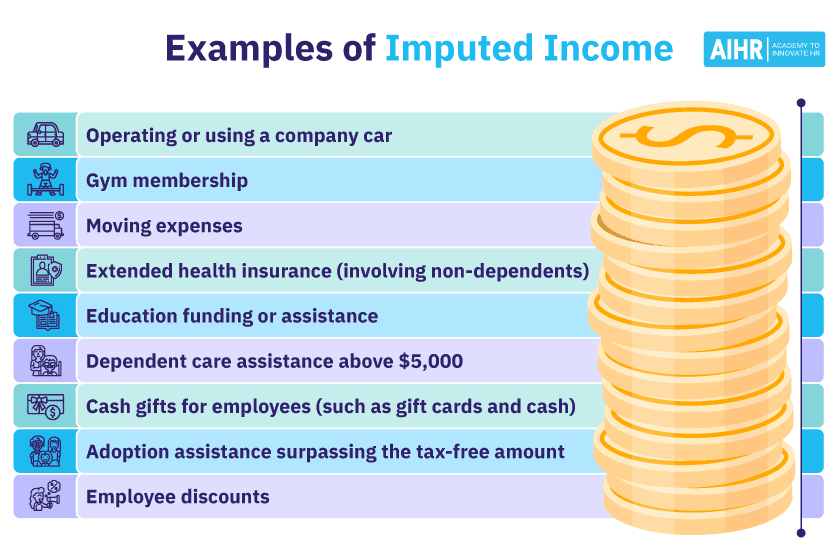
Common examples: The lawyer should review examples of common taxable fringe benefits that lead to imputed income:
Personal use of a company car.
Group-term life insurance coverage over $50,000.
Health insurance premiums for non-dependent domestic partners.
Educational assistance exceeding $5,250 per year.
Gym memberships or wellness benefits.
Excluded benefits: The lawyer can also mention benefits that are generally excluded from imputed income, such as:
Health insurance for employees, spouses, and dependents.
Small, occasional gifts or perks of minimal value (de minimis benefits).
There are special rules for the taxation of entities such as C Corps and S Corps that require CPA consultation to ensure that tax mistakes are not being made.
It is important to ensure that the S corporation’s favorable tax election is not compromised after the transfer and that it does not lose its passthrough tax treatment. Loss of the election would cause tax to be paid at the entity level as a C corporation rather than as a passthrough entity taxed on the shareholder’s income tax returns.
To Always Be a Human Being First, and My Role Second. To First, Do No Harm, then to provide the best legal outcome, smoothest process, best value, and to make a positive difference in the life of every client.
Christopher S. Mulvaney’s Mantra:
May I be filled with loving kindness for all life. May I be safe from dangers within and without. May I be healthy in body, mind, socially, and spiritually. May I be at ease and happy, doing good in the world.
May You be filled with loving kindness for all life. May You be safe from dangers within and without. May You be healthy in body, mind, socially, and spiritually. May You be at ease and happy, doing good in the world.
I am an experienced solo estate planning, debtor bankruptcy, and real estate attorney. At my law firm in Bellevue, Washington between Eastgate and Factoria, I do things a little differently. I am passionate about helping people take control of their lives.
One of my primary practice areas is urgent (bankruptcy), and the other is important, but not urgent (estate planning). Not letting the urgent crowd out the important is key. I have made a choice to include the positive difference I make in the life of each client in how I calculate profit. This means I have higher job satisfaction, and happy clients who confidently give referrals.
My goal is that my work is transformative for people during a challenging time in their lives. At Mulvaney Law Offices, PLLC (MLO), you will not find a gatekeeper. There are no forgotten cases hiding on an associate’s cluttered desk. It’s just me, working with each one of my clients one-on-one to resolve their legal concerns as favorably as possible.
As your lawyer, I will personally handle every aspect of your case. My office is not a factory churning out thousands of filings per year, where each case matters little. You, and your case, matter to me. You can see what clients have said about me, and leave your own reviews at these links.
Mulvaney Law Offices, PLLC is located in Bellevue, Washington, representing estate planning & chapter 7 and chapter 13 bankruptcy, clients in all 39 Washington Counties.
Washington State residents can meet with me in Zoom/DocuSign from anywhere in the world, and I can notarize their electronic signatures because I am a remote online notary. Just email me an image of your photo ID.